Yarn Explorer
Four things a yarn can be.
Never all four.
Drag each one up to what you actually need. Every yarn that cannot meet it drops out, and says exactly why.
Fibre type and how many plies are in the yarn.
2 yarns are out because of this one.
Mean fibre diameter in microns. Lower is softer against skin.
2 yarns are out because of this one.
Abrasion resistance of the fibre, and whether nylon is blended in.
1 yarn is out because of this one.
Whether it takes a wool machine cycle, and how easily it felts.
Nothing is dropping out on this axis.
8 of 13 yarns still qualify.
Fine merino
17.5 μmThe finest wool we knit. Most people who say wool itches do not feel this one, but you pay for that in thickness and in wear.
- Gives
- Softest wool on the site
- Costs
- Thin, and the first to wear at the elbows
Merino 2-ply
18.5 μmThe middle of everything, which is why most of the range is knitted in it. Nothing about it is extreme.
- Gives
- The fewest compromises
- Costs
- It wins no single axis
Chunky merino
18.5 μmFour plies of the same 18.5 μm fibre. The warmest thing here that is not cashmere.
- Gives
- Warmest wool we knit
- Costs
- Heavy, and slow to dry
Cashmere blend 30
17.4 μmThirty percent cashmere by weight, seventy percent merino. We print both numbers because a blend without numbers tells you nothing.
- Gives
- Cashmere hand at two thirds the price
- Costs
- Still delicate, still hand-wash territory
Merino-cashmere
17.8 μmFifteen percent cashmere is enough to change how it feels and not enough to make it delicate.
- Gives
- Nearly cashmere-soft, still washable on a wool cycle
- Costs
- Neither the softest nor the toughest
Wool-silk
19.5 μmA quiet sheen and a smooth drape, bought at the price of snagging.
- Gives
- The only shine in the range
- Costs
- Snags on watches, rings, zips
Wool-cotton
21 μmA four-season weight. Half the warmth of pure wool and half the fuss.
- Gives
- Wearable in April and October
- Costs
- Not warm enough for February
Alpaca blend
25 μmHairier and heavier than wool, and warmer than its weight suggests. It sheds. Dark trousers will show it.
- Gives
- Warm out of proportion to its weight
- Costs
- Sheds, mats, and you will feel the guard hairs
Dropped out, and why
Lambswool drops out: at 24 μm most people feel it. If you are sensitive on the neck, do not start here.
Cashmere drops out: it is the least abrasion-resistant fibre on this site. Bag straps and desk edges will show first.
Also short on care ease.
Cotton drops out: it is a plant fibre with no crimp. It does not trap air the way wool does.
Cotton-linen drops out: it is knitted open on purpose, for summer. It is the coolest thing we make.
Also short on softness.
Wool 80 / nylon 20 drops out: 21 μm wool plus nylon reads firm and a little wiry on the neck.
Why it works this way
Most shops describe every yarn as good at everything.
Read enough knitwear pages and you will find cashmere described as durable, lambswool described as soft, and cotton described as warm. Each of those is a stretch, and together they leave you with no way to choose.
Fibre properties trade against each other, and the trades are physical. Fineness is what makes a fibre feel soft and what makes it abrade faster. Loft is what makes a yarn warm and what makes it pill. Nylon buys wear resistance with hand feel.
So the tool above does not rank yarns. It removes them, and tells you which property did the removing.
pick which two matter, then buy for those two
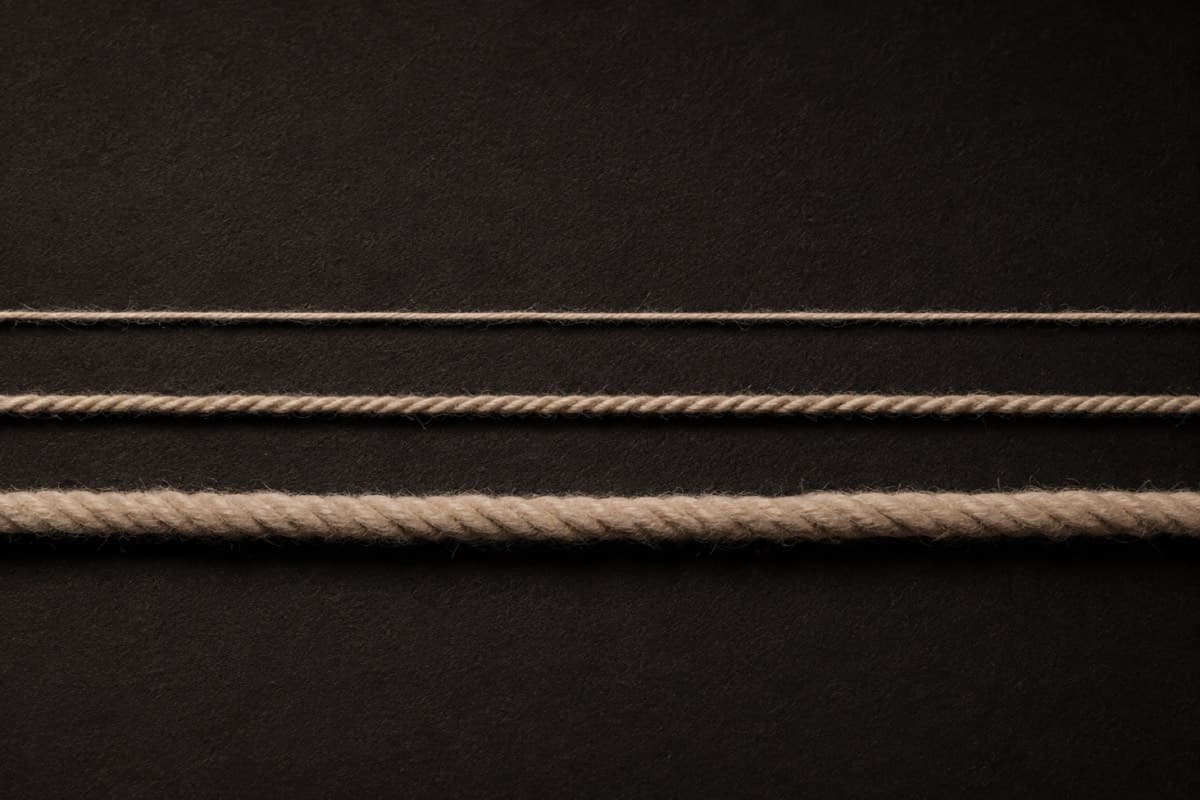
The same fibre at one, two and four plies. Same softness, three different amounts of warmth.
Every yarn on this site, side by side
| Yarn | μm | Warmth | Softness | Durability | Care ease | What it costs you |
|---|---|---|---|---|---|---|
| Fine merino | 17.5 | 3 | 5 | 3 | 4 | Thin, and the first to wear at the elbows |
| Merino 2-ply | 18.5 | 4 | 4 | 4 | 4 | It wins no single axis |
| Chunky merino | 18.5 | 5 | 4 | 4 | 3 | Heavy, and slow to dry |
| Lambswool | 24 | 4 | 3 | 3 | 3 | You will feel it, and it will pill |
| Cashmere | 15.5 | 5 | 5 | 1 | 1 | Wears out first, hand wash only |
| Cashmere blend 30 | 17.4 | 4 | 5 | 2 | 2 | Still delicate, still hand-wash territory |
| Merino-cashmere | 17.8 | 4 | 5 | 3 | 3 | Neither the softest nor the toughest |
| Cotton | — | 2 | 4 | 4 | 5 | Barely warmer than a shirt |
| Cotton-linen | — | 1 | 3 | 4 | 5 | Crisp at first, creases on purpose |
| Wool-nylon | 21 | 4 | 2 | 5 | 4 | Firmer hand, less soft on skin |
| Wool-silk | 19.5 | 3 | 4 | 2 | 2 | Snags on watches, rings, zips |
| Wool-cotton | 21 | 3 | 4 | 4 | 4 | Not warm enough for February |
| Alpaca blend | 25 | 5 | 4 | 2 | 2 | Sheds, mats, and you will feel the guard hairs |
Scores are our own reading of fibre diameter, ply, blend content and wash tolerance. They are a shortcut for comparison, not a laboratory result. The measured values — micron, ply, gauge, pilling grade and test method — are on every product page.